


There is no one simple price for a hot water system.
For Canberra homeowners, the final hot water system installation cost usually depends on the system type, size, access, brand, and whether the job is a like-for-like replacement or a more complex upgrade.
This is due to the variety of types of systems available, and the differing sizes of these systems. All prices include two components; the unit itself, and the labor. Typically, the unit accounts for 50–70% of the overall installation Cost, and the labor costs account for the remaining 30–50%. The typical Cost for labor for a licensed plumber in australia is $126 per hour. There is also a call out charge that Varies between $63 and $158. Depending on the complexity of the installation, a single residence installation usually requires One to three hours. However, the Cost may be increased if there are issues such as needing to upgrade the Gas line, moving the location of the flue, or changing from electric to Gas.
The “hidden” costs that consumers do not plan for: removing and disposing of the old unit (this is not always included); modifying piping when the new unit has different inlet and outlet positions; discovering older Gas lines that are too small for higher output continuous flow units.
Supply and install ranges below represent current Australian market pricing. Running costs are based on typical household consumption.
| Type description | install range | running costs | tank size | recommended for |
|---|---|---|---|---|
| Storage electric | $880 – $2,750 | ~$1,512/year | 250l — 315l | easy replacements on a tight budget; like-for-like swaps. |
| Storage Gas | $1,325 – $3,850 | ~$1,478/year | 130l — 170l | homes already connected to Gas; faster recovery compared to electric. |
| Continuous fast recovery Gas | $1,650 – $3,300 | less than storage | none | large families; multiple bathroom applications. |
It is important to note regarding the initial comparison of Gas storage vs. Electric storage: Gas storage Tanks are generally smaller in size due to Gas heating the contents of the tank quicker than an electric element. Therefore, a home of four using a 250–315 liter electric storage system could potentially operate on a 135–170 liter Gas storage system. The lower purchase price of the smaller Gas storage unit results in lower installation costs and reduced space requirements. Although the operating expenses are comparable, Gas has a longer term benefit over electric as the efficiency disadvantage widens after 10 years.
Why Gas storage Tanks are smaller than electric Tanks
The above is truly counter-intuitive and worthy of review prior to comparing quotes. Due to its rapid heating properties, Gas can rapidly recover the temperature of water in a tank. As a result, the volume of pre-heated water in a Gas storage tank can be significantly smaller than that needed in an electrically heated tank to meet demand. Conversely, electrically heated Tanks heat at a slower rate. To meet peak demand (such as four People showering sequentially between 6–8 am monday—friday) an electrically heated tank requires a greater reserve amount of hot water. Hence, a 250–315 liter tank is commonly used for a four person household on electric, whereas a 135–170 liter tank is typically sufficient for an equivalent Gas storage installation.
Continuous flow: sizing is different from storage
Gas continuous flow units are designed according to flow rate in liters per minute (l/m), not by tank capacity. There is no tank. Instead, they continuously produce hot water as it flows through them. Thus, the determining factor for sizing these units is not how many residents are living in the home, but rather how many outlets will be open simultaneously.
For example rheem states that their 26 l/m unit will support up to five residents across two-to-two-and-One-half bathrooms. While their 27 l/m unit is rated as the largest capacity unit in their range and supports six residents or three bathrooms. Residents requiring low usage and/or having fewer than two bathrooms may find that a 16–20 l/m unit meets their needs and provides better economic options.
Premiums for purchasing oversized continuous flow units that exceed the resident’s actual simultaneous outlet needs provide real dollars wasted in unused capacity.
Sizing: the number One installation error
The basic sizing formula is 50 liters of hot water per person per day. Therefore, a household consisting of four individuals would require approximately 200 liters of hot water per day. daily totals however do not equate to maximum drawdown. Maximum drawdown occurs at periods of peak usage such as mornings monday through friday between 6–8 am. During this time period, if three consecutive showers occur at twelve liters-per-minute each lasting eight minutes, then a total of 288 liters of total water would be consumed. Since hot water comprises most of this total amount, a 250-liter electric storage system could deplete in excess of half its capacity prior to completing all three showers. Only if there were some recovery time during this period would additional hot water be available for the final third shower. A 315-liter tank or a continuous flow unit would have ample capacity.
| Number of bedrooms/residents | size | resident size | description |
|---|---|---|---|
| 1–2 People | 125 liters — 160 liters | 12 — 16 lpm | compact continuous flow |
| 3–4 People | 250 liters — 315 liters | 20 — 24 lpm | medium duty |
| 5+ People | 315 liters — 400 liters | 24 — 27 lpm | multiple bathroom; high demand |
| Off-peak electric tariff | add 50-60 percent capacity | n/a | n/a |
A key trap associated with off-peak electric tariffs relates to sizing: an off-peak electric tariff only allows an electric storage system to recharge between 10 pm and 7 am. Consequently, the system must contain sufficient pre-heated hot water to last until the next charging cycle begins. As such, an off-peak tariff-based electric storage system serving three People must contain enough stored capacity to meet their needs for approximately 1.5 days. Therefore, an under-specified 160 liter electric storage system for three People represents an under-sizing error for off-peak tariffs.
Another sizing principle worth knowing: size the hot water system to accommodate future growth (i.e., size for bedrooms not for occupants). An electric storage system typically lasts from 8 to 12 years. By year five, the occupancy profile within a three bedroom house could be completely different. At present, the differential between buying a 250-liter electric tank versus a 315-liter electric tank is relatively minor ($150–300). However, if you had bought an under-sized tank and needed to replace it three years early due to increasing household numbers, you would incur costs ranging from $1,500 to $3,000 based on system specifications.
Which brand and why
The brand chosen impacts upon three aspects that cannot be determined from viewing a quote sheet: parts availability should a part fail; warranty coverage provided by the manufacturer; and installer familiarity with the products offered by the manufacturer.
| Brand | country of origin | benefits | warranty highlights |
|---|---|---|---|
| Rheem | Rydalmere NSW | Australian made. Widest parts availability network (approximate 40% market share) | up to 12 year cylinder warranty |
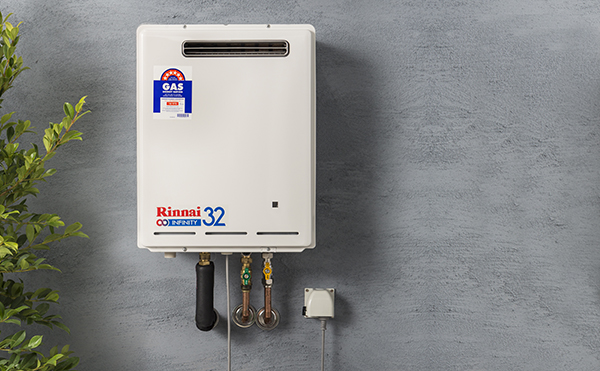
| Rinnai | Japan | benchmark continuous flow product. Largest continuous flow heat exchanger warranty (12 years) | 12 year heat exchanger warranty on continuous flow products |
| Dux | australia new south wales manufactured. | Dual handed connections allow installers more flexibility in connecting piping to Tanks. | 10 year warranty |
| Thermann | australia/japan/germany | rapidly expanding brand with growing distribution networks. Fastest delivery times from suppliers. | 12 year heat exchanger warranty on continuous flow products |
| Bosch | Germany | compact continuous flow designs compatible with hydraulic start (does not require power source.) | Varies by model. |
Rheem’s near monopoly status (approximately 40%) is largely due to a practical advantage — rheem has parts readily available at every major plumbing wholesaler throughout australia. When a critical component fails in winter and needs immediate replacement to restore service rather than wait on parts delivery — this advantage becomes invaluable. Additionally, rheem’s Rydalmere factory has been producing products locally for over eighty years.
Rinnai is considered the industry benchmark for Gas continuous flow products primarily because their continuous flow heat exchanger warranty extends for 12 years. This extended warranty duration adds significant long-term dollar value on continuous flow installations where the Cost of replacing failed heat exchangers can become quite expensive.
While Dux’s dual handed design allows installers to connect piping to Tanks from either side — reducing labor costs for installers doing like-for-like replacement jobs involving difficult access locations.
Thermann is available exclusively via Reece’s distribution network. Similar to rinnai, Thermann offers the same continuous flow heat exchanger warranty duration (12 years) and enjoys Reece’s national distribution network resulting in consistent inventory levels and predictable lead-times.
Over 500 thousand units have now been sold into australia and New Zealand by Thermann — providing proof positive of its established reputation — not new entry level risks with regard to unknown local service capabilities
Determining Whether To Fix Or To Replace Your Hot Water System
When your hot water system is no older than eight years old and has one single point of failure, a bad component, a defective thermostat, or a leaking pressure relief valve it is likely cheaper to fix rather than replace the system. The cost to fix will be considerably lower than buying a brand new unit, and due to the age of the existing system there is sufficient remaining useful life to justify fixing it.
When your hot water system is ten years old or older, and is failing repeatedly, and/or when active corrosion is present in your cold water supply line, the system has reached the end of its useful life economically. Replacing parts in this type of system merely extends the life of a worn out system. The first repair typically results in another within twelve months as additional aging components begin to fail. In many cases, the total cost of two repairs in two years on a 12-year-old system will exceed the cost of a complete replacement and then you are still left with a fourteen year old system operating on borrowed time.
In the middle ground, which includes ages 8-10, the decision to fix or replace will depend upon the nature of the problem(s) experienced by your hot water system, and the condition of your tank. A reputable plumber who has evaluated your hot water system should be able to provide you with a clear opinion regarding whether purchasing a repair provides enough remaining useable life for your investment to delay replacement by a year or two.
How to choose the right installer
Before you confirm a quote, ask yourself (and have answered in writing prior to signing), “Is the quoted price for supply and installation only, does it include the removal and disposal of my old unit?” “If unforeseen problems occur on the day of installation how are those problems going to be handled/what is their pricing method?” “Does the manufacturer warranty the products used for this job and does the installer also warrant their workmanship.” “Who would I call if I experience a malfunction with the installed equipment within the first year after installation?”
Any written quote that addresses all of these questions may serve as your base-line. For gas and electric hot water installations, see our hot water systems page to find out what we install and how to obtain a quote.